Note
Go to the end to download the full example code.
Number Detector Example
This example demonstrates the use of the
NumberDetector.
We show three related measurement concepts:
Observation returns the full outcome distribution for a measurement without selecting a particular branch.
Detection samples one concrete measurement outcome and returns the corresponding post-measurement state.
Postselection conditions the state on a chosen measurement outcome.
The example first measures a simple product input state and then repeats the observation/detection process after interference on a 50/50 beam splitter.
For a number detector, the outcomes correspond to the possible photon numbers detected in the measured path.
from __future__ import annotations

import numpy as np

from symop.devices.models.beamsplitters.beamsplitter import BeamSplitter
from symop.devices.models.detectors.number_detector import NumberDetector
from symop.devices.models.sources.number_state_source import NumberStateSource
from symop.modes.envelopes.gaussian import GaussianEnvelope
from symop.modes.labels.path import Path
from symop.modes.labels.polarization import Polarization
from symop.polynomial.state.ket import KetPolyState
import symop.viz as VI
Setup
Create a two-photon source and a number detector.
The source emits photons into a path with a Gaussian spectral envelope
and horizontal polarization. Since n=2, each source prepares a
two-photon excitation in its output mode.
src = NumberStateSource(
    envelope=GaussianEnvelope(omega0=100.0, sigma=50.0, tau=0.0),
    polarization=Polarization.H(),
    n=2,
)

det = NumberDetector()
Generate the input state
Start from vacuum and populate two distinct paths with identical two-photon states. The joint state therefore contains a total of four photons, distributed across two input paths.
vac = KetPolyState.vacuum()

state_a = src(vac, ports={"out": Path("src_out")}).with_label("in")
state_b = src(vac, ports={"out": Path("src_out_aux")}).with_label("in_aux")

state = state_a.join(state_b).with_label("joint")
VI.display(state)
Observe the measurement
Observation is a non-destructive query. It does not collapse the state. Instead, it returns the full probability distribution over all possible detector outcomes for the selected path.
Here the detector measures the path src_out. Since the total state
contains four photons, the possible number outcomes are determined by
how many photons can be found in that path.
observation = det.observe(state=state, ports={"in": Path("src_out")})
VI.display(observation)
Detect
Detection represents one concrete realization of the measurement. It returns a sampled outcome together with the corresponding post-measurement state.
detection = det.detect(state=state, ports={"in": Path("src_out")})
VI.display(detection)
Post-measurement state after detection
This is the collapsed state associated with the sampled detection event.
VI.display(detection.state)
Postselection
Postselection conditions the original state on a chosen outcome. In this case we reuse the outcome sampled above and explicitly build the corresponding conditional branch.
postselection = det.postselect(
    state=state,
    ports={"in": Path("src_out")},
    outcome=detection.outcome,
)
VI.display(postselection)
Postselected state
This is the state conditioned on the selected outcome.
VI.display(postselection.state)
Interfere the input state on a beam splitter
Next, we interfere the two input paths on a 50/50 beam splitter. Interference changes the amplitudes and therefore changes the measurement probabilities at the output ports.
bs = BeamSplitter(theta=np.pi / 4)

state_interfered = bs(
    state,
    ports={
        "in0": Path("src_out"),
        "in1": Path("src_out_aux"),
        "out0": Path("bs_out0"),
        "out1": Path("bs_out1"),
    },
).with_label("interfered")

VI.display(state_interfered)
Observe the output distribution after interference
We now observe the photon-number distribution in one beam-splitter output path. The set of possible outcomes is still determined by the allowed photon numbers in that path, but the probabilities are changed by interference.
interfered_observation = det.observe(
    state=state_interfered,
    ports={"in": Path("bs_out0")},
)
VI.display(interfered_observation)
Quick Plot
VI.plot(interfered_observation)
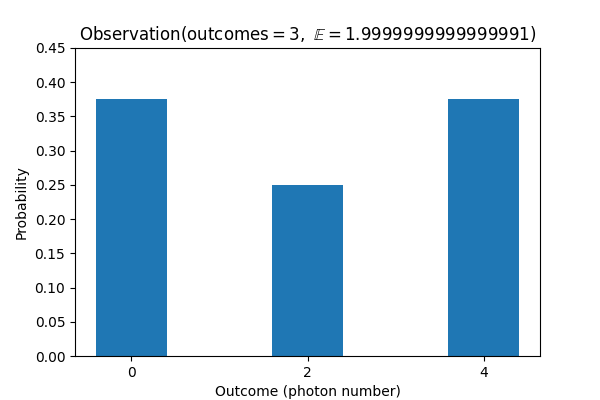
(<Figure size 600x400 with 1 Axes>, <Axes: title={'center': '$\\mathrm{Observation}\\left(\\mathrm{outcomes}=3,\\ \\mathbb{E}=1.9999999999999991\\right)$'}, xlabel='Outcome (photon number)', ylabel='Probability'>)
Detect one output event after interference
As before, detection returns one concrete sampled outcome and the corresponding collapsed branch.
interfered_detection = det.detect(
    state=state_interfered,
    ports={"in": Path("bs_out0")},
)
VI.display(interfered_detection)
Post-measurement state after interfered detection
VI.display(interfered_detection.state)
Total running time of the script: (0 minutes 1.830 seconds)