Envelopes
Overview
An envelope describes the temporal or spectral shape of an optical
mode. All envelopes implement the abstract base class
BaseEnvelope.
Important concrete implementations include:
It is represented as a normalized function
which encodes the shape of the field, independent of photon number or energy.
Normalization
Envelopes are normalized such that
This reflects that envelopes describe mode structure, not intensity.
Time and frequency representations
An envelope can be expressed in the frequency domain via
The inner product becomes
Implementations provide access to both domains and may use either representation depending on context.
Gaussian envelopes
Gaussian envelopes form a particularly important subclass:
closed under many operations
analytically tractable
efficient to evaluate
They are parameterized by central frequency, width, temporal offset, and phase.
Many transformations preserve this structure or produce finite mixtures of Gaussian components.
Filtered and numerical envelopes
When analytic representations are not available, envelopes can be represented numerically.
Typical workflow:
evaluate spectrum on a grid
apply transformations pointwise
reconstruct via FFT
This provides generality at the cost of performance.
Examples
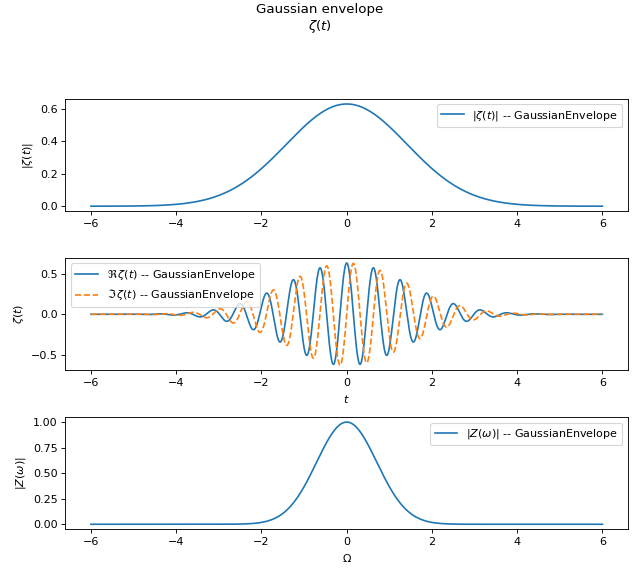
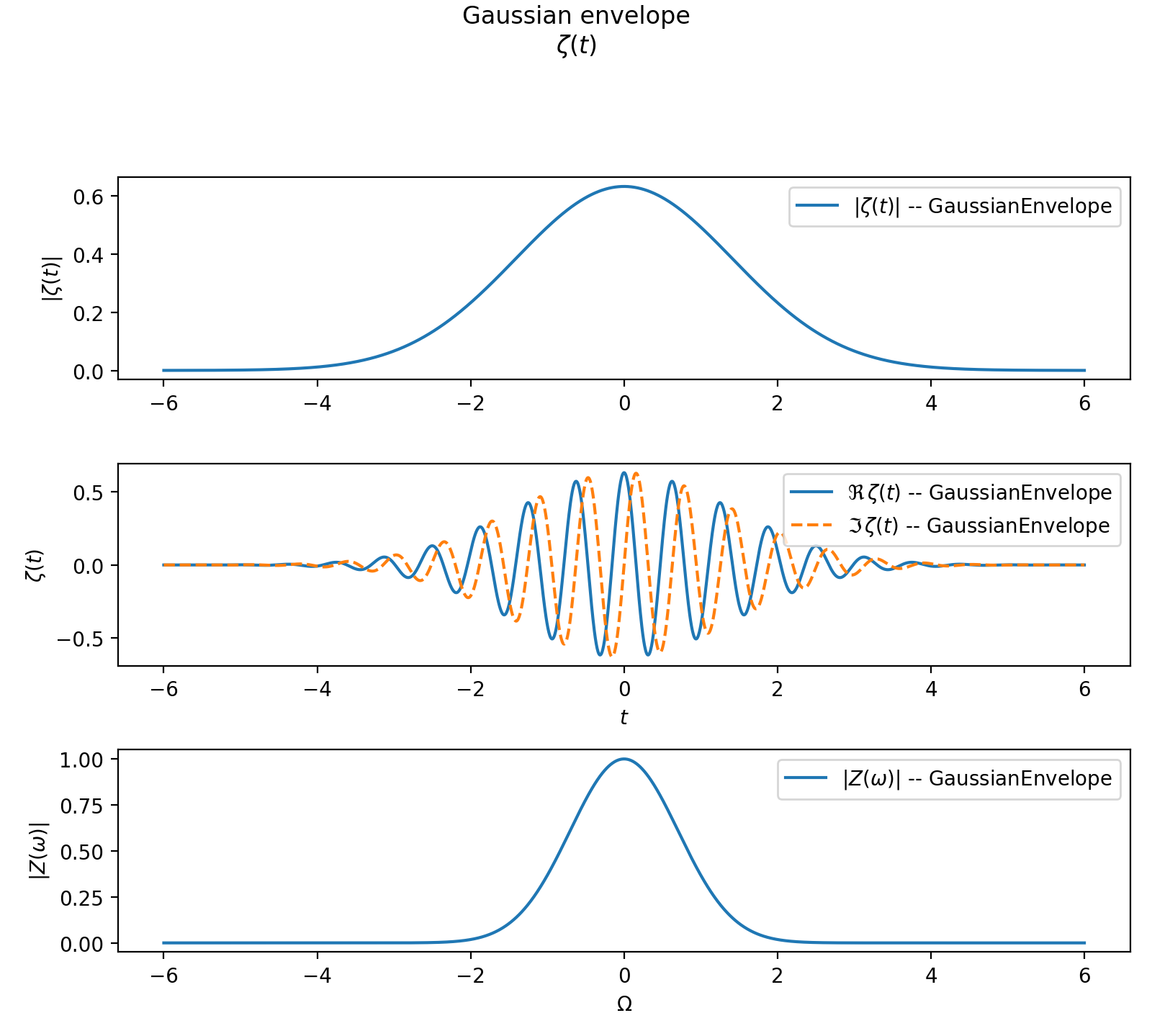
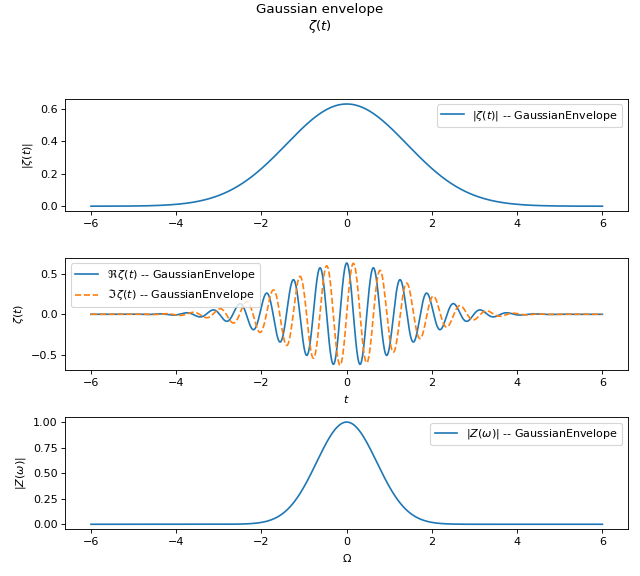
Gaussian envelope
import numpy as np

from symop.modes.envelopes import GaussianEnvelope
import symop.viz as viz

env = GaussianEnvelope(
    omega0=10.0,
    sigma=1.0,
    tau=0.0,
    phi0=0.0,
)


viz.plot(
    env,
    show_freq=True,
    normalize_spectrum=True,
    freq_relative=True,
    title="Gaussian envelope",
    show=False,
)
(Source code, png, hires.png, pdf)
Envelope overlap
from symop.modes.envelopes import GaussianEnvelope

env1 = GaussianEnvelope(omega0=10.0, sigma=1.0, tau=0.0)
env2 = GaussianEnvelope(omega0=10.0, sigma=1.0, tau=1.0)

overlap = env1.overlap(env2)

print(overlap)
(-0.7404780254568896+0.48009694530049957j)
This measures how distinguishable two temporal modes are. Identical envelopes yield an overlap of 1, while separated envelopes reduce the overlap.
Gaussian mixture (implicit)
Certain operations (e.g. filtering) produce mixtures of Gaussian components. These are still represented analytically when possible, without requiring numerical sampling.
Users typically do not construct mixtures manually; they arise as the result of transformations.
Design notes
Envelopes describe mode shape, not energy.
They are always normalized.
They support both analytic and numerical evaluation.
They form the continuous part of mode distinguishability.